Nature’s Kaleidoscope
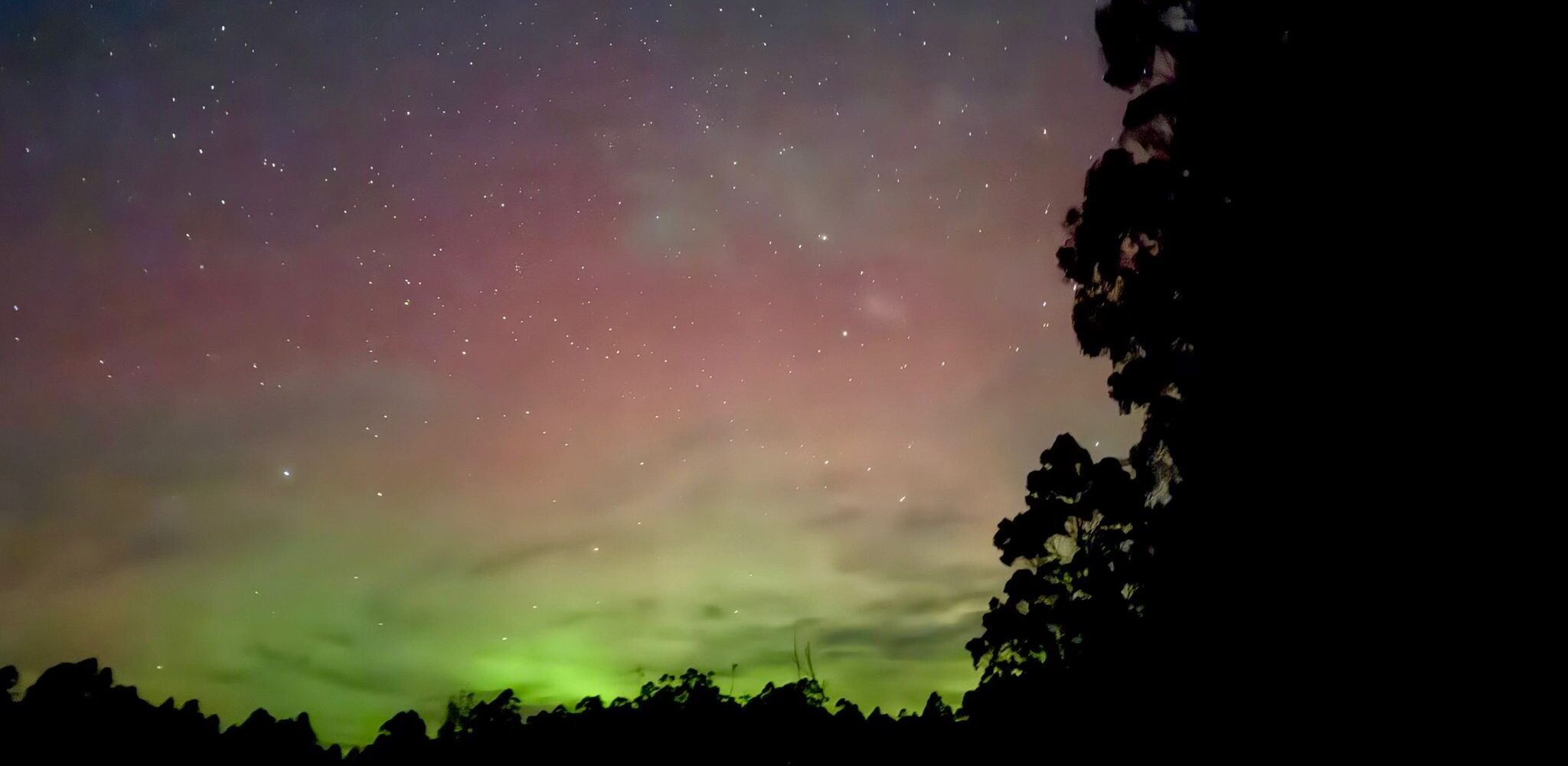
The Aurora Australis at Highcroft Hills
As our roses rest in winter dormancy, our garden returns to muted shades of green. But even in winter’s darkest depths, nature’s most fantastical light show can colour the skies above Tasmania.
The Southern Lights – the Aurora Australis – are caused by energised particles from the sun colliding with Earth’s magnetic field and upper atmosphere. These micro explosions of shimmering, swirling rainbows rhythmically frolic in a delicate, dreamlike dance of greens, reds, violets and pinks. It’s utterly surreal; so it’s understandable why this mesmerising natural phenomenon is woven into folklore and legend, as something that was both feared and revered.
For many ancient and indigenous cultures, the auroras represented ancestral spirits and gods communicating with the living. Often the message was foreboding: a sign of coming illness, war, fire and death. But equally, it could be a message of change, hope and bounty. Even the name ‘Aurora’ comes from the Roman goddess of the dawn, which symbolises renewal and the triumph of light of darkness.
The Aurora Australis is most frequently enjoyed by the few scientists that live and work in Antarctica. This is because the Aurora Oval, a ring-shaped region of frequent Aurora activity, sits around 10° to 20° from the Earth’s magnetic poles. In the northern hemisphere, several countries are located at this latitude: Canada, Norway, Russia, Alaska in the US. But in the southern hemisphere, it’s just Antarctica.
Highcroft Hills sits at roughly 42º South. For us to see the Aurora Australis solar activity needs to be higher. So when this celestial luminescence does grace the skies over Tasmania, it feels all the more magical.
2025 and into early 2026 was a particularly good period for us, because it was the culmination of the sun’s 11-year magnetic cycle.
Plenty of solar energy meant that even our neighbours across the Bass Straight in mainland Australia witnessed this breathtaking light display.
Although rare, the Auroras (both Borealis and Australis) have even been seen close to the equator. Powerful geomagnetic storms, when the sun sends massive bursts of energy towards Earth – enough to disrupt satellites, radio communications and electrical power grids – expand the Aurora Oval sometimes to 75º from the poles. Hawaii, the Caribbean and Namibia have, at some point in their not too distant histories, experienced an Aurora light show. Regardless of how frequently we see the Aurora, we’ll never tire of this ethereal waltz of coloured lights illuminating the night sky over our sleeping rose garden.